TSXV: VCU

OTCQB: VCUFF

Home

3

Projects

Alaska, U.S. Projects

Palmer VMS Project

Alaska, USA

Delta Project

Alaska, U.S.

Helm Bay Project

Alaska, U.S.

British Columbia, Canada Projects

Poplar Porphyry Project

BC, Canada

Woodjam Project

BC, Canada

Miller Project

BC, Canada

Copperview Project

BC, Canada

Redgold Project

BC, Canada

News

Media

Contact

June 18, 2026

Vizsla Copper Commences 2026 Drill Program at the Palmer Project

Vancouver, British Columbia, June 18, 2026 – Vizsla Copper Corp. (TSXV: VCU, OTCQB: VCUFF, FRANKFURT: 97E0) (“Vizsla Copper” or the “Company”) is pleased to report that diamond drilling has commenced at its Palmer VMS Project in Southeast Alaska.

The fully funded 2026 exploration program represents the first phase of a multi-year strategy designed to expand the Project's critical minerals resource base, evaluate new discovery opportunities, and advance the technical understanding of the broader Palmer district.

Two drill rigs are currently operating on site, with approximately 10,000 metres of drilling planned during the 2026 field season. Initial drilling is focused on the Palmer Deposit's South Wall Zone (see Figure 1), where previous drilling identified a high-grade copper-rich core within Zone 1, including some of the highest copper grades intersected on the property to date.


Craig Parry, Executive Chairman and CEO, commented:

"With drilling now underway, our team is focused on building upon the success of recent exploration at Palmer. The 2026 program is designed to expand high-grade mineralization at the South Wall Deposit while evaluating several priority targets across the district. As our geological understanding continues to improve, Palmer is increasingly demonstrating the scale, exploration upside, and critical minerals endowment that we believe distinguishes it as one of the premier exploration opportunities in Southeast Alaska."

Peter Mercer, Senior Vice President, Alaska, added:

" The 2026 program reflects a balanced approach between resource expansion and discovery while advancing the environmental and technical understanding of the Project. The drill rigs are currently focused on areas where previous drilling has returned some of the highest copper grades encountered on the property, while mountain crews prepare additional drill sites to evaluate the mineral potential between the Palmer and AG deposits. As the season progresses, our focus remains on safe operations, disciplined execution, and generating the technical information needed to better understand the full potential of the district."

2026 Program Now Underway

The 2026 program combines resource growth, new discovery opportunities, and technical studies designed to further advance the Company's understanding of the Palmer district.  Diamond drilling will initially focus on the Palmer Deposit, where initial holes are testing high-priority targets within the South Wall system. This first phase of drilling is designed to further define and expand the high-grade copper-rich core identified within Zone 1 and improve confidence within existing mineralized Zones 2 and 3 through targeted infill drilling.

Drilling later this season is planned at two priority exploration targets located between the existing deposits. The HG Prospect, located west of the Palmer Deposit, hosts significant copper-zinc-silver mineralization exposed over more than 600 metres of strike length and shares several geological characteristics with the South Wall mineralized system.

The Waterfall Prospect, situated between the Palmer and AG deposits, represents an important target where geological, geochemical, and alteration characteristics suggest potential to add additional mineralization between the known deposits.

Beyond these priority drill targets, the Company will continue evaluating several regional prospects across the broader Palmer district, including Mount Henry Clay, Christmas Creek, and other underexplored target areas. Follow-up field investigations will include geological and structural mapping, high-resolution photogrammetry, target refinement, and additional diamond drilling.

The exploration program is supported by an integrated technical initiative that includes advanced geological modelling, geophysical reinterpretation, critical minerals assessment, and continued environmental baseline studies. Together, these programs are intended to improve the Company's understanding of the Palmer district while supporting future technical, economic, and engineering studies.
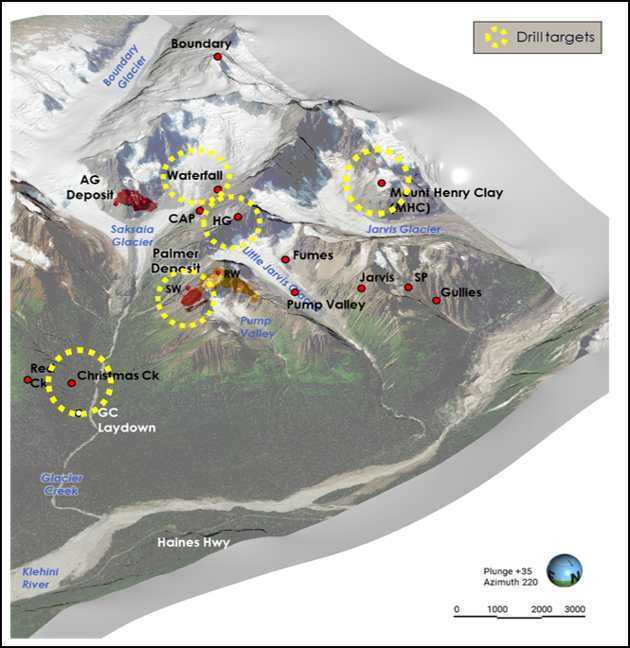
     Figure 1: Drilling target areas planned for the 2026 field season

Multi-Year Technical Strategy

The Palmer Project hosts copper, zinc, silver, gold, and barite mineralization, commodities recognized as strategically important to domestic supply chains, infrastructure development, energy systems, and national security applications. The 2026 field season represents the first stage of a broader multi-year technical program focused on resource growth, geological understanding, environmental baseline collection, and technical trade-off and optimization studies.

Over the coming field seasons, Vizsla Copper intends to continue advancing the technical knowledge base required to support future economic and engineering studies while maintaining a strong focus on exploration and discovery across the broader Palmer district.

As reported in the 2025 NI 43-101 Technical Report, the Palmer Project hosts an Indicated Mineral Resource of 4.77 million tonnes grading 1.69% copper and 5.17% zinc, containing approximately 178 million pounds of copper and 543 million pounds of zinc, and an Inferred Mineral Resource of 12.0 million tonnes grading 0.57% copper and 3.92% zinc, containing approximately 152 million pounds of copper and 1.04 billion pounds of zinc, in addition to significant silver, gold, and barite. The existing resource remains open for expansion and provides a strong foundation for continued exploration across more than 15 kilometres of prospective stratigraphy within the broader Palmer district.

Further updates will be provided as drilling progresses and assay results become available.

About Vizsla Copper

Vizsla Copper is a Cu-Au-Mo focused mineral exploration and development company headquartered in Vancouver, Canada. The Company is primarily focused on its Palmer VMS project in Southeast Alaska, and its Poplar and Woodjam porphyry-related projects in Central and Southern British Columbia. All of the Company’s projects are well situated amongst significant infrastructure. The Company’s growth strategy is focused on the exploration and development of the properties within its portfolio in addition to value accretive acquisitions. Vizsla Copper's vision is to be a responsible copper explorer and developer in the stable mining jurisdictions of Alaska and British Columbia, and it is committed to socially responsible exploration and development, working safely, ethically and with integrity.

Vizsla Copper is backed by Inventa Capital Corp., a premier investment group founded in 2017 with the goal of discovering and funding opportunities in the mineral resource sector. Additional information about the Company is available on SEDAR+ (www.sedarplus.ca) and the Company’s website (www.vizslacopper.com).

Qualified Person and National Instrument 43-101 Disclosure

The Company’s disclosure of technical or scientific information in this press release has been reviewed and approved by Peter Mercer, P.Geo., Senior Vice President, Alaska for Vizsla Copper. Mr. Mercer is a Qualified Person as defined under the terms of National Instrument 43-101.

References

1SRK - Parsons, B. and Kelloff, K. (2025). NI 43-101 Technical Report, Mineral Resource Estimate, Palmer Project, Alaska, USA. Report prepared for Constantine Metal Resources Ltd. by SRK Consulting (U.S.), Inc. Effective Date: January 13, 2025

Contact Information: For more information, please contact:

Craig Parry, Executive Chairman, Chief Executive Officer

Tel: (604) 364-2215 | Email: info@vizslacopper.com

Neither the TSX Venture Exchange nor its Regulation Services Provider (as that term is defined in the policies of the TSX Venture Exchange) accepts responsibility for the adequacy or accuracy of this release.

FORWARD LOOKING STATEMENTS

The information contained herein contains “forward-looking statements” within the meaning of the United States Private Securities Litigation Reform Act of 1995 and “forward-looking information” within the meaning of applicable Canadian securities legislation. “Forward-looking information” includes, but is not limited to, statements with respect to the activities, events or developments that the Company expects or anticipates will or may occur in the future, including, without limitation, planned exploration activities. Generally, but not always, forward-looking information and statements can be identified by the use of words such as “plans”, “expects”, “is expected”, “budget”, “scheduled”, “estimates”, “forecasts”, “intends”, “anticipates”, or “believes” or the negative connotation thereof or variations of such words and phrases or state that certain actions, events or results “may”, “could”, “would”, “might” or “will be taken”, “occur” or “be achieved” or the negative connotation thereof. Forward-looking statements in this news release include, among others, statements relating to the Company’s exploration plans.

Such forward-looking information and statements are based on numerous assumptions, including among others, that the results of planned exploration activities are as anticipated, the anticipated cost of planned exploration activities, that general business and economic conditions will not change in a material adverse manner, that financing will be available if and when needed and on reasonable terms, that third party contractors, equipment and supplies and governmental and other approvals required to conduct the Company’s planned exploration activities will be available on reasonable terms and in a timely manner. Although the assumptions made by the Company in providing forward-looking information or making forward-looking statements are considered reasonable by management at the time, there can be no assurance that such assumptions will prove to be accurate.

Forward-looking information and statements also involve known and unknown risks and uncertainties and other factors, which may cause actual events or results in future periods to differ materially from any projections of future events or results expressed or implied by such forward-looking information or statements, including, among others: negative operating cash flow and dependence on third party financing, uncertainty of additional financing, uncertainties associated with mineral resource estimates and the absence of mineral reserves, the limited operating history of the Company, the influence of a large shareholder, aboriginal title and consultation issues, reliance on key management and other personnel, actual results of exploration activities being different than anticipated, changes in exploration programs based upon results, availability of third party contractors, availability of equipment and supplies, failure of equipment to operate as anticipated; accidents, effects of weather and other natural phenomena and other risks associated with the mineral exploration industry, environmental risks, commodity price volatility including fluctuations in copper, gold and molybdenum prices, changes in laws and regulations, community relations and delays in obtaining governmental or other approvals.

Although the Company has attempted to identify important factors that could cause actual results to differ materially from those contained in the forward-looking information or implied by forward-looking information, there may be other factors that cause results not to be as anticipated, estimated or intended. There can be no assurance that forward-looking information and statements will prove to be accurate, as actual results and future events could differ materially from those anticipated, estimated or intended. Accordingly, readers should not place undue reliance on forward-looking statements or information.  The Company undertakes no obligation to update or reissue forward-looking information as a result of new information or events except as required by applicable securities laws

Explore Vizsla Copper

Palmer VMS Project

Explore Vizsla Copper’s flagship project in Southeast Alaska

Poplar Project

Explore Vizsla Copper’s copper-gold porphyry project in British Columbia

Investors

Access the latest presentation, news, and investor materials

COPPERVIEW PROJECT

Notes on Mineral Resource Estimate

Please advise on Copperview Disclaimers. Or we can remove the link to this content.

WOODJAM PROJECT

Notes on Woodjam Historical Estimates

The Woodjam estimates are historical estimates within the meaning of National Instrument 43-101 – Standards of Disclosure for Mineral Projects. The historical estimates are not being treated by Vizsla Copper as current mineral resources or mineral reserves. A Qualified Person has not done sufficient work to classify the historical estimates as current mineral resources or mineral reserves. Mineral resources are not mineral reserves and do not have demonstrated economic viability.

The historical estimates relate to the Southeast, Deerhorn and Takom deposits and were prepared for Gold Fields Horsefly Exploration Corp. and Consolidated Woodjam Copper Corp. with an effective date of May 15, 2013.

The Southeast historical estimate was disclosed in the technical report titled NI 43-101 Technical Report for 2012 Activities on the Woodjam South Property, Cariboo Mining Division, British Columbia, prepared by Ross Sherlock, Ph.D., P.Geo., Gold Fields Canada Exploration BV, and Alex Trueman, P.Geo., MAusIMM CP(Geo), Gold Fields Exploration, Inc., with an effective date of May 15, 2013. The Southeast historical estimate was completed by Alex Trueman, P.Geo., MAusIMM CP(Geo), Chief Resource Geologist, Gold Fields Exploration Inc.

The Deerhorn and Takom historical estimates were disclosed in the technical report titled NI 43-101 Technical Report for 2012 Activities on the Woodjam North Property, Cariboo Mining Division, British Columbia, prepared by Ross Sherlock, Ph.D., P.Geo., Gold Fields Canada Exploration BV, Jacqueline Blackwell, Ph.D., P.Geo., Gold Fields Canada Exploration BV, and Twila Skinner, P.Geo., Gold Fields Canada Exploration BV, with an effective date of May 15, 2013. The Deerhorn and Takom historical estimates were completed by Brian Wolfe, MAIG, Principal Resource Geologist, Gold Fields Australasia Pty. Ltd.

The Southeast and Deerhorn historical estimates were prepared using localized multivariate uniform conditioning, and the Takom historical estimate was prepared using ordinary kriging. Each historical estimate used a cut-off grade of US$8.60/t. The NSR calculation used metal price assumptions of US$1,650/oz Au and US$3.90/lb Cu and recovery assumptions of 69% Au and 85% Cu. The historical estimates were reported within modelled open pit shells based on price assumptions of US$1,650/oz Au and US$3.90/lb Cu.

Vizsla Copper considers the historical estimates relevant because they provide information regarding mineralization identified at the Woodjam Project and assist in guiding exploration planning. Vizsla Copper considers the historical estimates reliable for these limited purposes because they were prepared by qualified professionals using drilling and sampling information collected using modern methods available at the time. However, Vizsla Copper has not independently verified the historical estimates and readers should not rely on them as current mineral resources or mineral reserves.

Additional work required to verify or upgrade the historical estimates as current mineral resources may include, as applicable, data compilation, confirmation drilling, resampling, data verification, verification of historical drill hole locations and survey data, review and validation of historical QA/QC data, density verification, updated geological modelling, a site visit by a Qualified Person and preparation of a current mineral resource estimate and technical report in accordance with NI 43-101.

A Qualified Person has not done sufficient work to classify the historical estimates as current mineral resources or mineral reserves, and Vizsla Copper is not treating the historical estimates as current mineral resources or mineral reserves. There can be no assurance that the historical estimates, in whole or in part, will ever be verified as current mineral resources or converted into mineral reserves.

POPLAR PROJECT

Notes on Poplar Historical Estimate

The Poplar estimate is a historical estimate within the meaning of National Instrument 43-101 – Standards of Disclosure for Mineral Projects. The historical estimate is based on the technical report titled Technical Report 2021 Update on the Poplar Deposit, Omineca Mining Division, British Columbia, prepared for Universal Copper Ltd. by James Ashton, P.E., SME-RM and Warren Robb, P.Geo., with a report date of September 2, 2021 and filed under Universal Copper Ltd.’s profile on SEDAR on September 8, 2021.

The historical estimate was reported at a 0.20% Cu cut-off within a modelled mineralized solid. The historical estimate comprises 152.3 million tonnes grading 0.32% Cu, 0.009% Mo, 0.09 g/t Au and 2.58 g/t Ag in the indicated category, and 139.3 million tonnes grading 0.29% Cu, 0.005% Mo, 0.07 g/t Au and 4.95 g/t Ag in the inferred category.

The historical estimate was prepared using a three-dimensional solid to constrain the interpolation of mineralization, using a 0.1% Cu grade limit as a guide. Large internal waste zones and certain post-mineral dykes were modelled. A total of 133 drill holes totaling 38,854 metres within the modelled area were used in the estimate. Copper, molybdenum, gold and silver assays within the mineralized solid were capped at 1.8% Cu, 0.16% Mo, 0.80 g/t Au and 70 g/t Ag, respectively. Five-metre composites were calculated and used for variography. Blocks were 5 m x 5 m x 10 m and were estimated for Cu, Mo, Au and Ag by ordinary kriging. Classification as indicated or inferred was based on each block’s proximity to data and grade continuity within the mineralized solid.

Vizsla Copper considers the historical estimate to be relevant because it provides information regarding the scale and grade of mineralization identified at the Poplar Project and assists in guiding future exploration and evaluation work. Vizsla Copper considers the historical estimate to be reliable for these limited purposes because it was prepared by qualified professionals using drilling, sampling and geological information available at the time and estimation methods considered reasonable when the estimate was prepared. However, Vizsla Copper has not independently verified the historical estimate and it should not be relied upon as a current mineral resource or mineral reserve.

The historical estimate used the categories “indicated” and “inferred”. These categories appear to be generally consistent with the corresponding mineral resource categories under NI 43-101 and the CIM Definition Standards; however, Vizsla Copper has not completed the work required to verify the historical estimate as a current mineral resource.

Additional work required to verify or upgrade the historical estimate as a current mineral resource may include, as applicable, confirmation drilling, verification of historical drill hole locations and survey data, validation of the drill hole database, review and validation of historical QA/QC data, density verification, metallurgical test work, updated geological modelling, application of current CIM Definition Standards and preparation of a current mineral resource estimate and technical report in accordance with NI 43-101.

A Qualified Person has not done sufficient work to classify the historical estimate as current mineral resources or mineral reserves, and Vizsla Copper is not treating the historical estimate as current mineral resources or mineral reserves. Mineral resources are not mineral reserves and do not have demonstrated economic viability.

PALMER PROJECT

Notes on Mineral Resource Estimate

(1) Mineral Resources, which are not Mineral Reserves, do not have demonstrated economic viability. The deposits have been classified as Indicated and Inferred based on confidence in the geological model, drill spacing. The estimate of Mineral Resources may be materially affected by environmental, permitting, legal, title, market or other relevant issues. The quantity and grade of reported Inferred Resources are uncertain in nature and there has not been sufficient work to define these Inferred Mineral Resources as Indicated or Measured Resources. There is no certainty that any part of a Mineral Resource will ever be converted into reserves.

(2) Mineral resources are reported using an assumed NSR which includes prices, recoveries and payabilities cut-off grade based on metal price assumptions*, variable metallurgical recovery assumptions**, mining costs, processing costs, general and administrative (G&A) costs and variable NSR factors. Mining (US$41.3), processing (US$23.92) and G&A costs (US$11.77) and Sustaining Capital (US$15.92) totaling US$92.9/t for Underground Mining.

(*) Metal price assumptions considered for the calculation of Metal Equivalent grades are: Gold (US$/oz 2,100.00), Silver (US$/oz 28.0), Copper (US$/lb 4.50), Lead (US$/lb 0.95) and Zinc (US$/lb 1.50)

(**) Cut-off grade calculations assume variable metallurgical recoveries as a function of grade and relative metal distribution. Average metallurgical recoveries are: SW/RW Zones: Gold (76.1%), Silver (90.2%), Copper (90.3%), Lead (82.9%) and Zinc (89.2%), AG Zone: Gold (66.0%), Silver (91.0%), Copper (54.8%), Lead (83.4%) and Zinc (94.8%) .

(3) NSR Calculations for SW/RW Domains: NSR= $77.25 x %Cu + $20.32 x %Zn + $9.64 x %Pb + $0.64 x g/t Ag + $43.07 x g/t Au

(4) NSR Calculation for AG Domain: NSR=$49.04 x %Cu + $22.25 x %Zn + $10.14 x %Pb + $0.70 x g/t Ag + $37.77 x g/t Au

(5) The resources are considered to have potential for extraction using underground methodology and constrained by mineable shapes. Resources are presented undiluted and in situ and are considered to have reasonable prospects for economic extraction.

(6) Barite as reported is shown for economic potential but has not been used in the NSR value at this stage.

(7) ZnEq defined by equation SW & RW = NSR value per block / $20.32; AG = NSR value per block / $22.25 (Note Barite has been excluded from the ZnEq and NSR calculations)

(8) CuEq defined by equation SW & RW = NSR value per block / $77.25; AG = NSR value per block / $49.04 (Note Barite has been excluded from the CuEq and NSR calculations)

(9) Mineral Resources are based on validated data, which have been subjected to QA/QC analysis, using capped, composited samples at 2m. Estimation has been completed using a combination of Ordinary Kriging and Inverse Distance estimation methodologies and classified based on confidence in the underlying data and drill spacing. Mineral resource tonnages have been rounded to reflect the precision of the estimate.

(10) The mineral resources were estimated by Benjamin Parsons, BSc , MSc Geology, MAusIMM (CP) #222568 of SRK, a Qualified Person.